
Church at Shepherds’ Fields
March 9, 2018
Today we spent the day in Beit Sahour and Bethlehem. Beit Sahour is a town just outside of Bethlehem and the location of the Shepherd’s fields. Literally, Beit Sahour means “Vigil of the Shepherds.” Mostly, this land was used by shepherds and their flocks and shepherds always had to be vigilant. This was the site of two historical moments in the Bible. The first, in the Old Testament, Ruth meets Boaz. From this lineage comes David and Jesus. The second, is the angel announcing the birth of Jesus to the shepherds in the field.
The church located on this holy site is incredibly beautiful, the dome above the church is full of holes/windows so that light is constantly streaming in, creating the effect of the angel descending to earth.

Dome above the church letting the light in.
The caves located at the site are also beautiful, being the same caves as were used 2000+ years ago. Not to mention, they are naturally occurring.
It really was a day of Jesus’ birth, because after the fields, we visited the Herodian (palace of King Herod the Great). It was from this palace that he decreed all infants in Bethlehem under the age of two be slaughtered so that a new King couldn’t dethrone him. Herod built this palace to be a paradise, with hot baths, cold swimming pools, gardens, and two palaces.
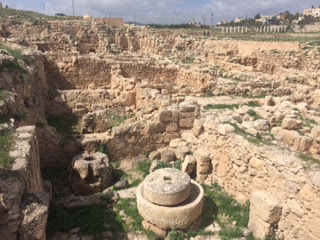
Remnants of the Byzantine farming community.
He even had a hill made for his palace to sit on so that he could look down at Bethlehem. To this day it is still known as “the paradise” by locals. Several hundred years later, the Byzantines came and made a farm community in the remnants of his palace.
During lunch we talked with Rev. Dr. Mitri Raheb, President of Daral Al Khalimah University. He has worked hard throughout his professional and personal life to build bridges between Muslims and Christians.
Note: he will be coming to Minneapolis, MN May 17-20th with a delegation who are bringing Palestinian culture and art to Westminster Presbyterian, the experience will be open to the public.

Star Street in Bethlehem
As I’ve stated in at least one previous entry, less than 2% of the population in Israel-Palestine is Christian, most of them are in the West Bank. However, Christians are an important part of the fabric in Palestine as they are mostly responsible for the healthcare and hospitals, schools, nonprofit organizations, and several are political leaders as well.
He went over more details of the situation and the conflict for us in a much more visual way, which was helpful, but then spent a great deal of time talking about the solutions.

Church of the Nativity, St. Catherine’s
The belief of Raheb’s work and the work of the University is that hope can still be found by educating the new generations of leaders in Palestine to be peacemakers. He told us many stories of students that he’s worked with who have gone on to change their communities, and even Palestine or the Middle East. They have started the first female soccer team in Palestine, who went on to create a national team, and finally to become a part of FIFA; they have also developed the first ever network of seminaries and Muslim religious colleges throughout the Arab world.

Icon of Mary breastfeeding Jesus
Finally, we ended our day in Bethlehem visiting the Church of the Nativity and the Milky Grotto. We were able to go into the Church of the Nativity: St. Catherine’s, but not actually see the site of the birth. However, much like the experience in the Church of the Holy Sepulcher, there were so many people lined up to look at a spot on the floor – which is now marble and enshrined. There was a 3 hour wait. The Milky Grotto was very unique and I’d never heard of it. The story goes, that on the way to Egypt Mary had to stop and feed Jesus. They pulled off to a small grotto and she fed him. As she did, a drop of her milk spilled out and when it hit the rock, the whole place turned white. Hundreds of people travel here daily, including many couples experiencing infertility.
The most notable thing about this site? All of the art and icons including exposed breasts. I’m sure it’s a sight I’ll never see again – at least in a Catholic Church.
Overall today was very relaxed. It was so nice to have a calm day after the chaos of yesterday. It gave me time to rest, think, and enjoy being here. So much less to right about today!
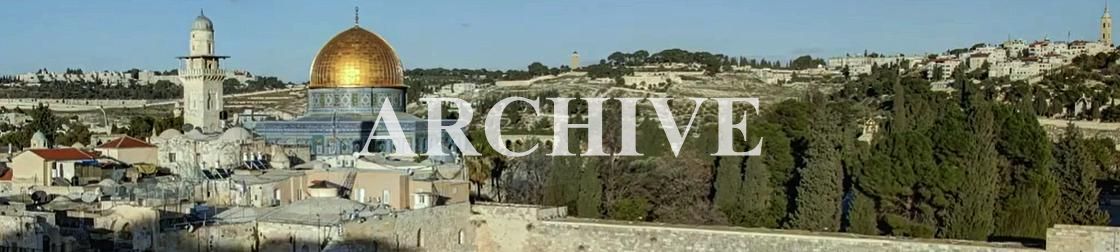
 We were given an incredible opportunity to tour both the Dome of the Rock and Al Aqsa Mosque, sacred sites that are normally difficult to access. Past conflict at these sites have limited visitors to Muslim worshippers and those with special permission.
  Our guide at these sites, Aouni, was a knowledgeable and gracious host as he led us into the majestic and ornate structures that are important holy places for Muslims to gather in prayer. The buildings themselves are beautiful and awe inspiring. The space is filled with an air of reverence and history. Aouni discussed the areas of the mosque that have been rebuilt in the past and explained the special meaning of the building’s design. He also showed as areas of the mosque that are preferred areas for praying. Aouni shared with us that he feels that the entire area is a holy place because of the devotion of individuals that gather there to pray and that wherever they choose to pray should be considered special holy place.
 As could be expected, there were many people gathered at the Western Wall, commonly referred to as the Wailing Wall. The wall is the last remaining wall of an ancient temple and is an important place to visit and share devotions, especially for many Jewish pilgrims visiting Israel. The special connection to this site was evident in watching the devout place their written prayers in cracks in the wall, touch the wall and press their heads to the wall in prayer. Men and women are required to pray on separate sides of the wall, however this did not deter one large group attending a Bar Mitzvah at the wall from celebrating together. Women leaned over one side to watch their male family members reveling on the other side and throwing candy to them. It was a celebratory break within an atmosphere of solemn reverence. The entire scene felt as if it was connecting us directly with the faithful of many years past.